Our story
We started with a fabric, not a collection.
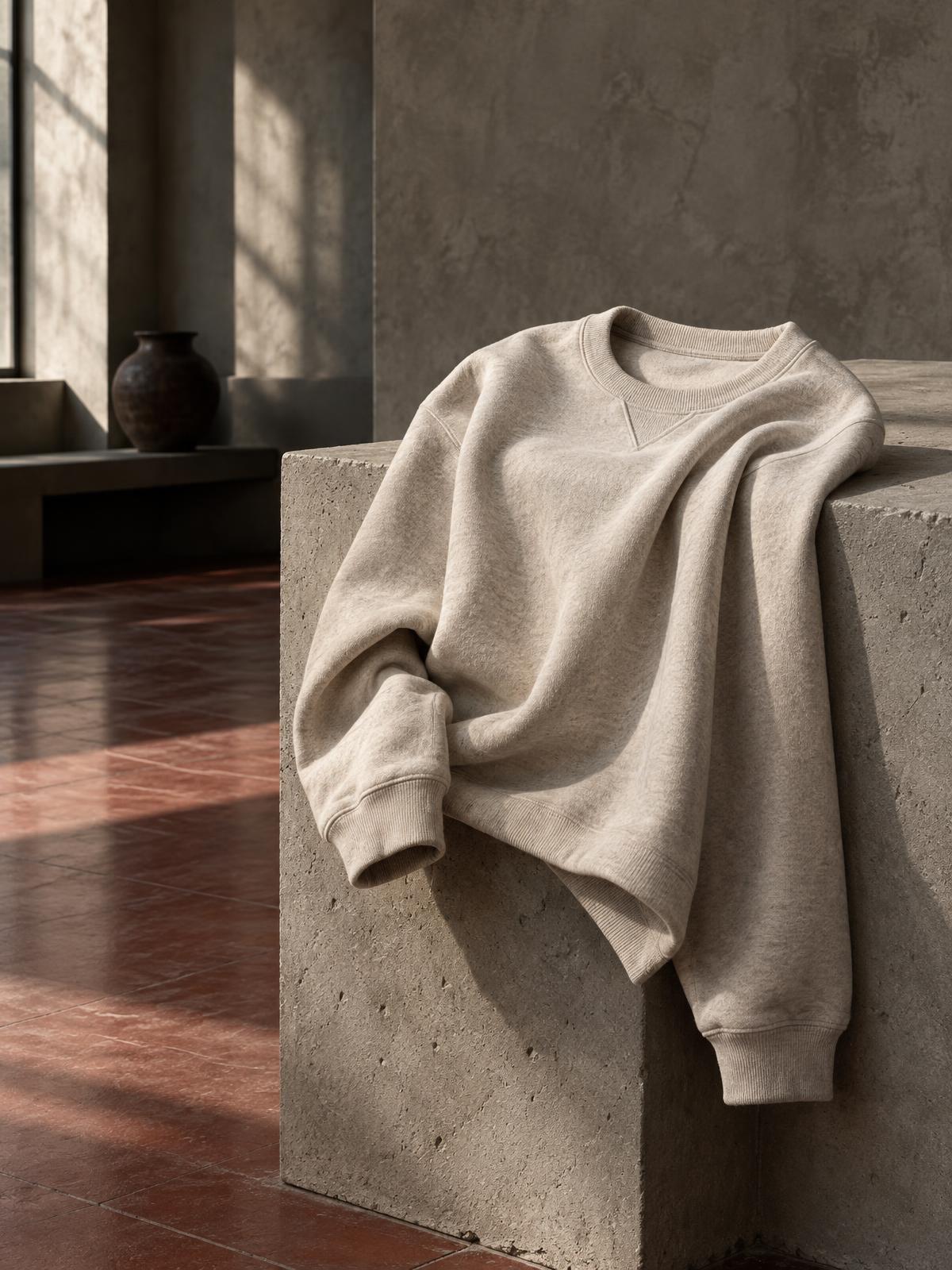
Lorenzo Barsotti began in a room with a scale, a washing machine and a roll of cotton jersey. The question was not what to design, but what a garment should weigh — and how that weight changes the way it hangs, creases and ages.
So the label works as a studio rather than a brand calendar. We take one fabric weight at a time, cut it, wash it, wear it for months, then correct it. What we release is a study: numbered, weighed, and printed with its own specification.
I grew up around people who measured quality by touch: a jacket that held its shape, a cotton that only got better after washing, a seam that stayed flat where cheaper work puckered. That sensibility became the brief. Not novelty, but evidence — clothes that prove themselves over years of wear.
Craftsmanship
Weight is the first signal. Construction is the second.
We use 7.4 oz combed cotton jersey for the tees and long sleeves, and 14 oz brushed-back fleece for the crewneck, hoodie and sweatpant. These are not industry averages; they are roughly double the weight of a typical basic, and the difference is immediate the moment you pick a piece up.
But weight alone is not enough. The collar has to recover its shape after repeated wear. The cuffs need density so they do not bag. The shoulder seam must lie flat under a coat. Every detail is tested against the reality of being worn, washed, and lived in — not photographed once and forgotten.
Each garment is cut with a clean silhouette and finished with a small, tonal label. No slogans, no graphics, no noise. The clothes are the statement.
Inspiration
Architecture, uniforms, and the color of quiet rooms.
The visual language of Lorenzo Barsotti comes from the spaces clothes move through: the soft mineral grey of poured concrete, the quiet teal of oxidised copper, the calm neutrality of a well-lit studio. These are not trend colors; they are background colors — stable, forgiving, easy to live beside.
The working method borrows from material research: swatch walls, wash tests, specification cards. The same patience you see in a ceramicist firing the same glaze twenty times, or a workwear factory refusing to change a pattern that already works.
That is the ambition here. Not to be noticed for what you are wearing, but to feel unmistakably yourself in it.
The method
Two weights. Three standards. Nothing to keep up with.
Chalk, Sand and Charcoal are dyed to a single standard across every study. Something bought this year sits beside something bought next year, because both were made to the same specification, and that specification does not move.
A study is only replaced when a sample measurably outperforms it: better recovery in the collar, less shrinkage after ten washes, a cleaner drape at the hem. If nothing beats it, nothing changes.
What you get is not something to keep up with, but a record of work: each garment numbered, weighed and made to be worn until it earns its creases.
Shop the studiesFrom the studio
“Tell me what a garment weighs and I can tell you how it will age.”
— Lorenzo Barsotti